Custom Lighting Spotlight: Salt Flats
Airports are rarely designed for stillness. They move with urgency—defined by scale, rhythm, and constant transition. So when a custom lighting installation invites a moment of pause—drawing the eye upward and softening the pace of the space—it becomes something more than functional. It becomes transformative.
At Salt Lake City International Airport, that moment belongs to a custom Hammerton chandelier—an expansive, sculptural installation inspired by one of Utah’s most surreal and famous natural landscapes: the Bonneville Salt Flats.
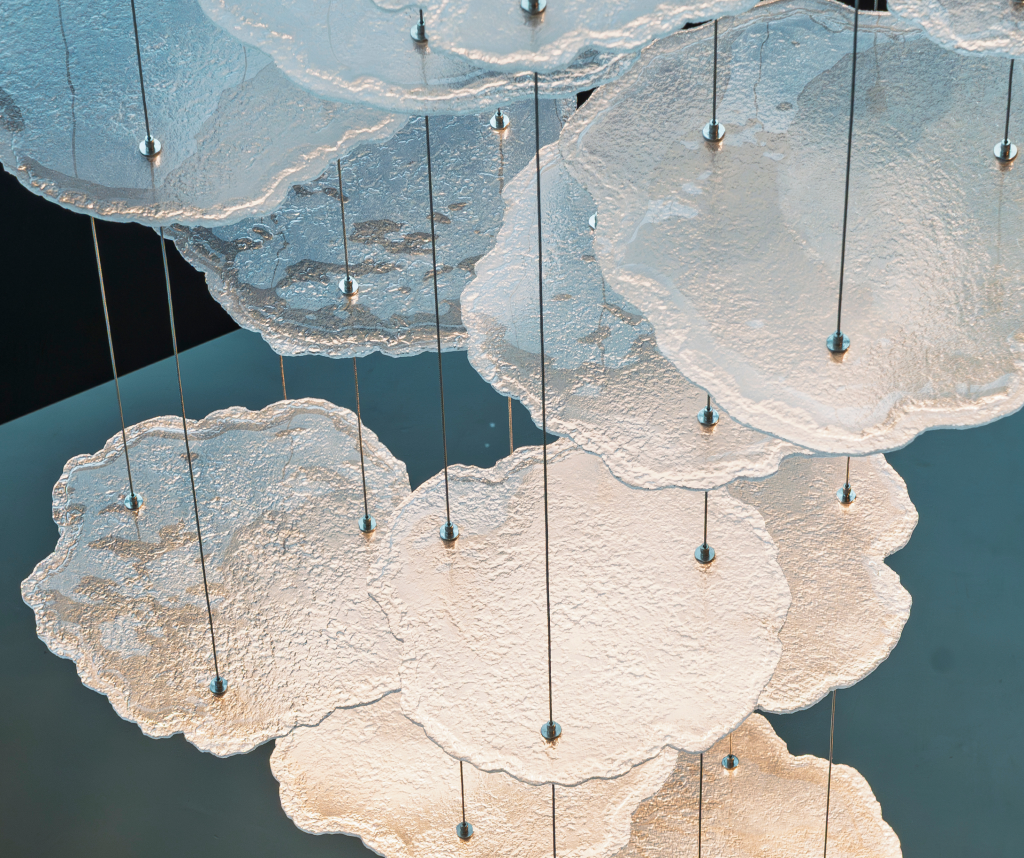
This wasn’t about creating another “large fixture.” The challenge was capturing something almost impossible to hold onto—the quiet, endless, reflective surface of the Salt Flats—and translating it into a suspended indoor form that still felt grounded in nature, even within constant motion.
That responsibility began with Davis Seegmiller, Hammerton’s head custom lighting industrial designer. Rather than simplifying the landscape, Davis leaned into its complexity—studying its fractured geometry, its layered mineral textures, and the way light shifts across its surface throughout the day. The concept wasn’t literal. It was interpretive: a suspended field of organic glass forms that carries the memory of the terrain rather than its shape.
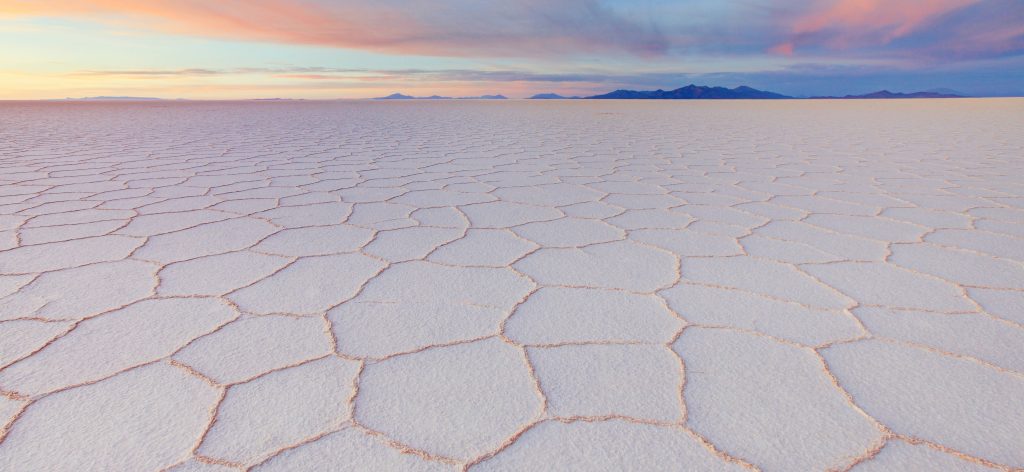
The Salt Flats are not uniform. They crack, shift, and evolve with time and climate. To reflect that, each glass element in the chandelier was individually hand formed—no molds, no repetition. Every piece carries its own subtle variation in thickness, edge, and texture, echoing the unpredictability of the landscape itself.
That level of uniqueness wasn’t a challenge to overcome. It was the point.
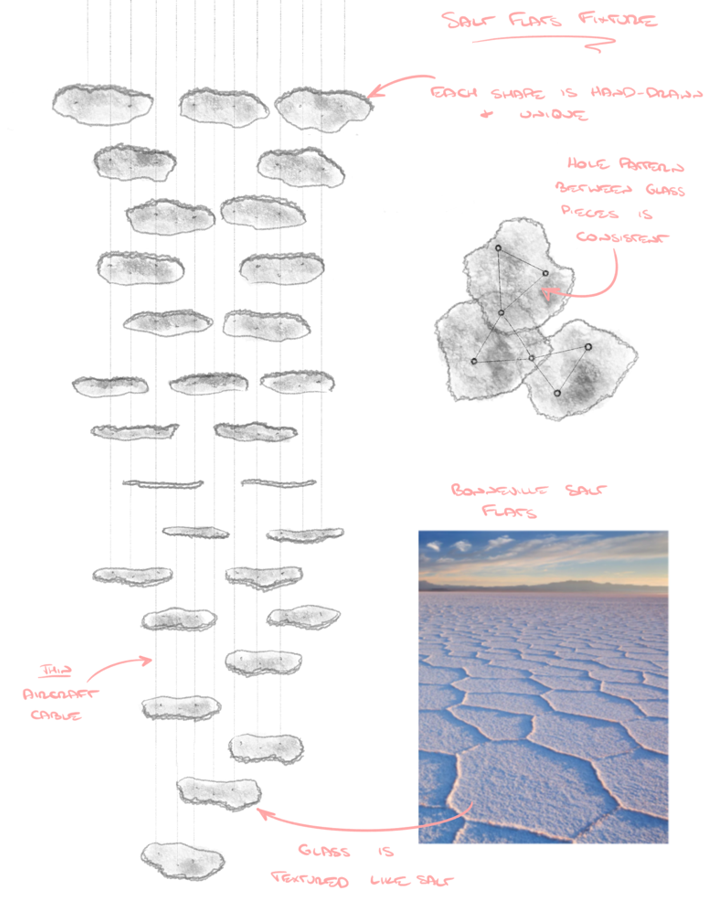
But concept alone doesn’t create form. This is where process takes over—and where this fixture begins to distinguish itself.
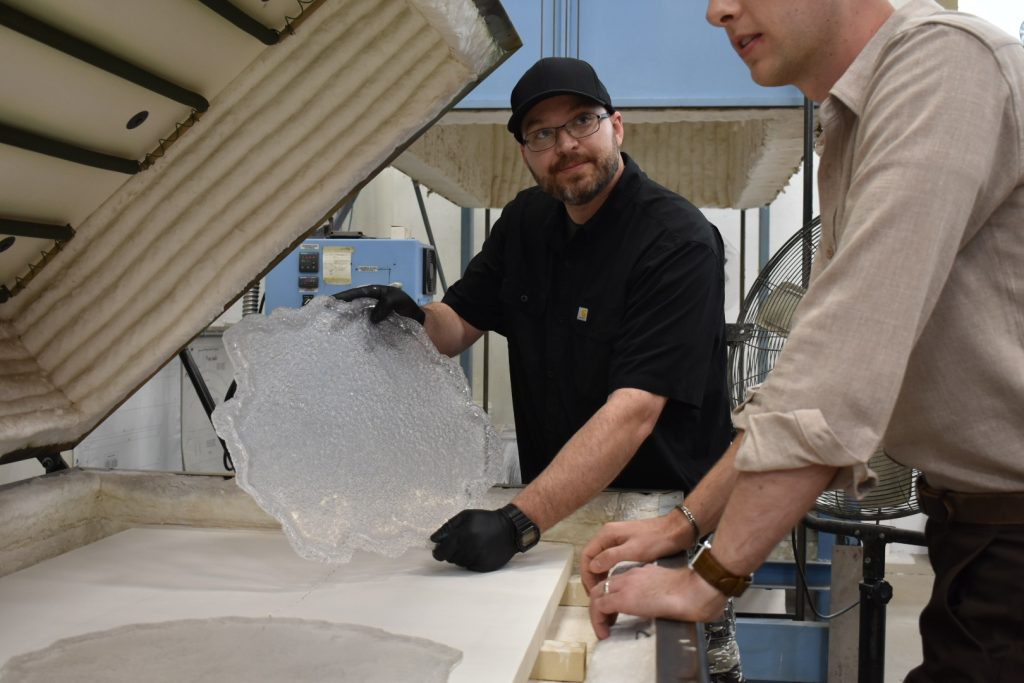
One of the most defining elements of the design came through a close collaboration between Davis Seegmiller and Nick Conner, Hammerton’s glass production supervisor. Together, they developed a custom glass texture through multiple rounds of experimentation—working by hand to achieve a gritty, refined surface quality inspired directly by the tactile character of the Salt Flats. The goal wasn’t visual mimicry. It was sensation. Something you could feel through the glass.
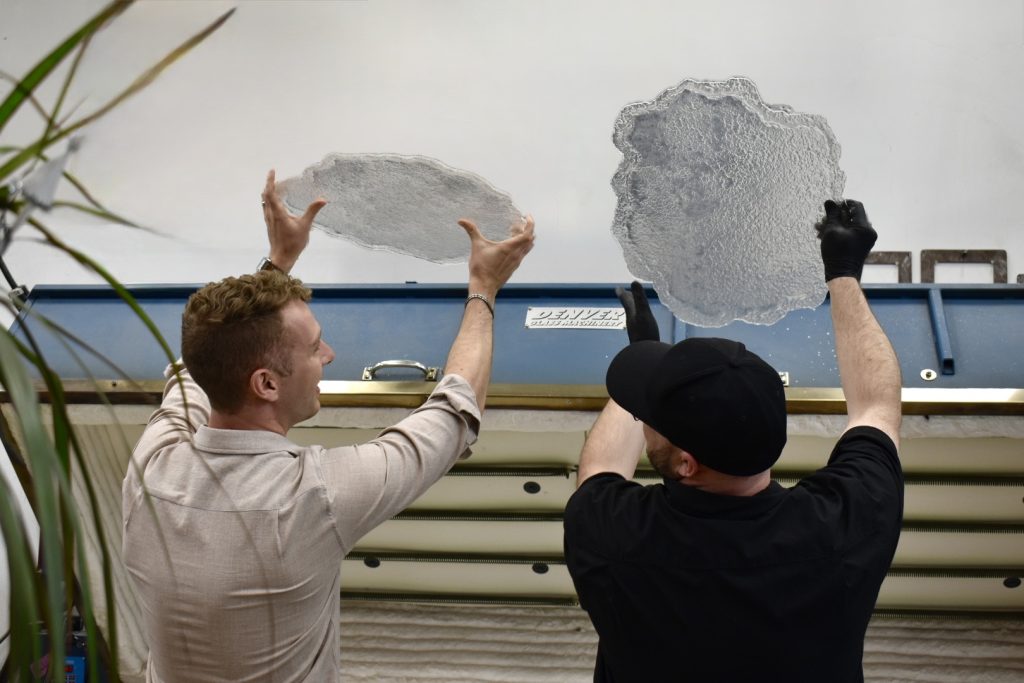
Once that texture was established, Nick took the process further by hand-carving the edges of each individual glass piece. Every edge was refined manually to ensure organic variation—no uniform cuts, no mechanical repetition. Each element carries slight differences in contour, giving the entire installation a living, irregular quality that responds differently from every angle.
This is where craftsmanship becomes the architecture of the piece.
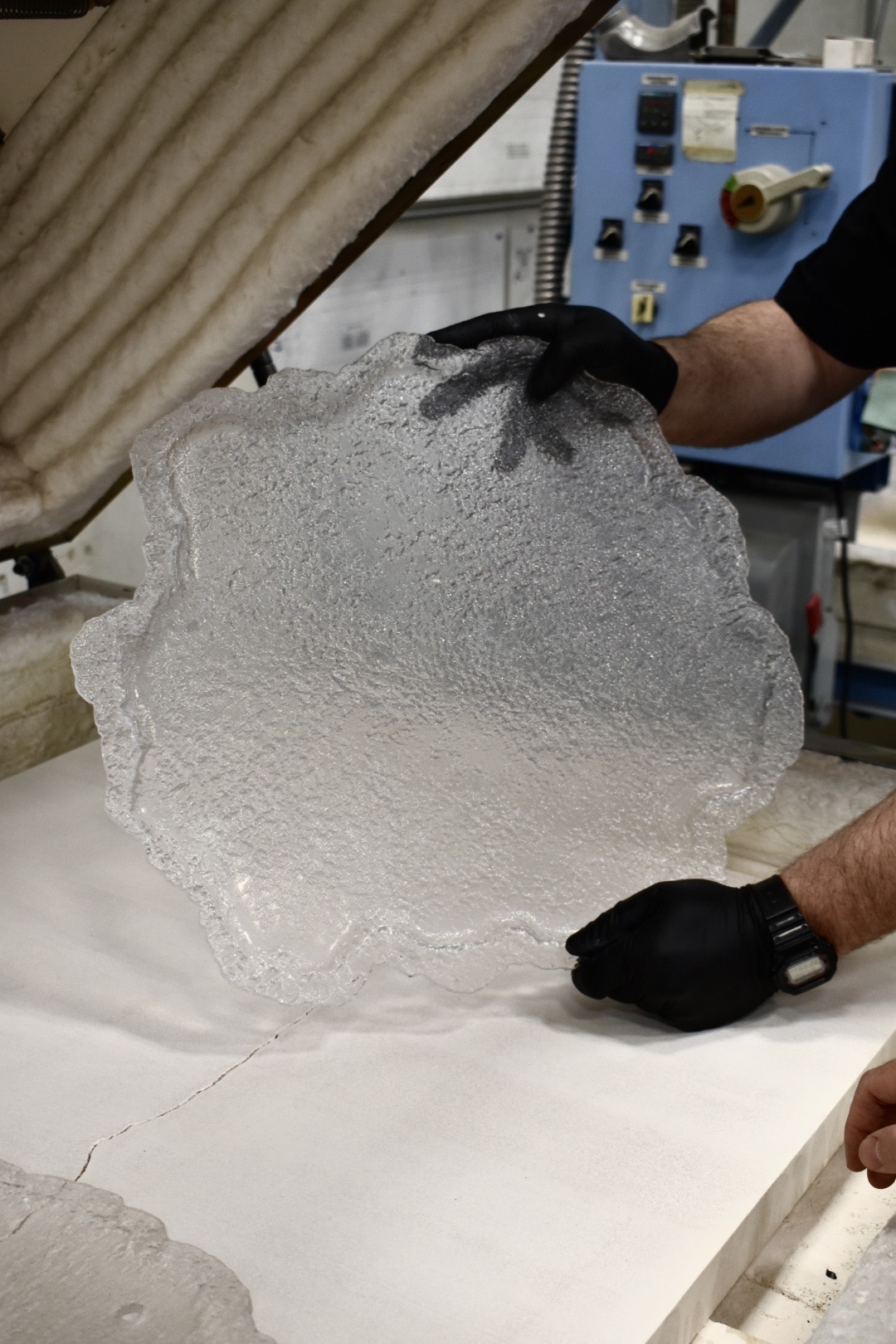
Kiln-fusing supported the formation of each glass element, allowing layers to settle and bond through controlled heatwork. But the defining characteristics—the texture, the edges, the irregularity—were all achieved by hand. Nothing about this installation was standardized. Every decision reinforced its individuality.
The result is a custom lighting design that feels alive.
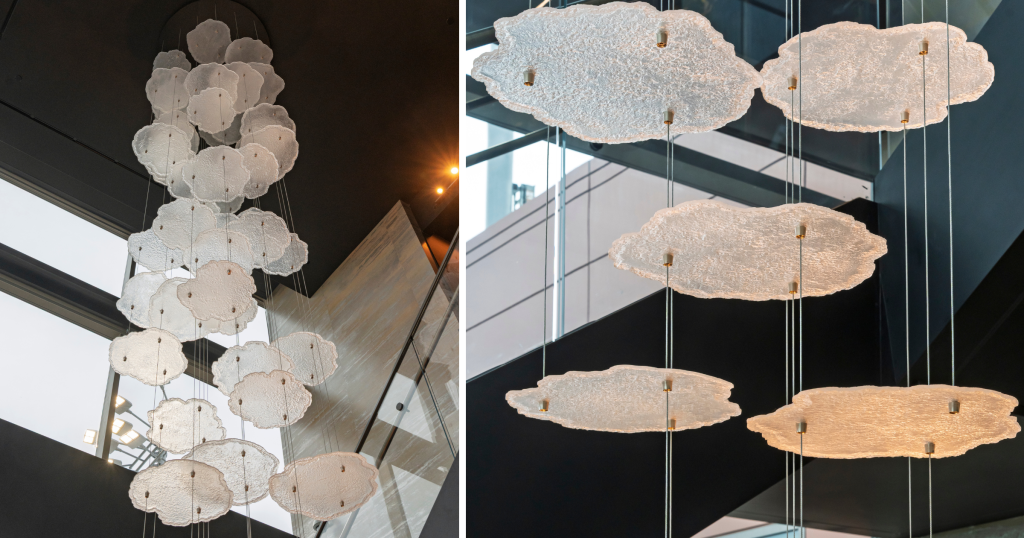
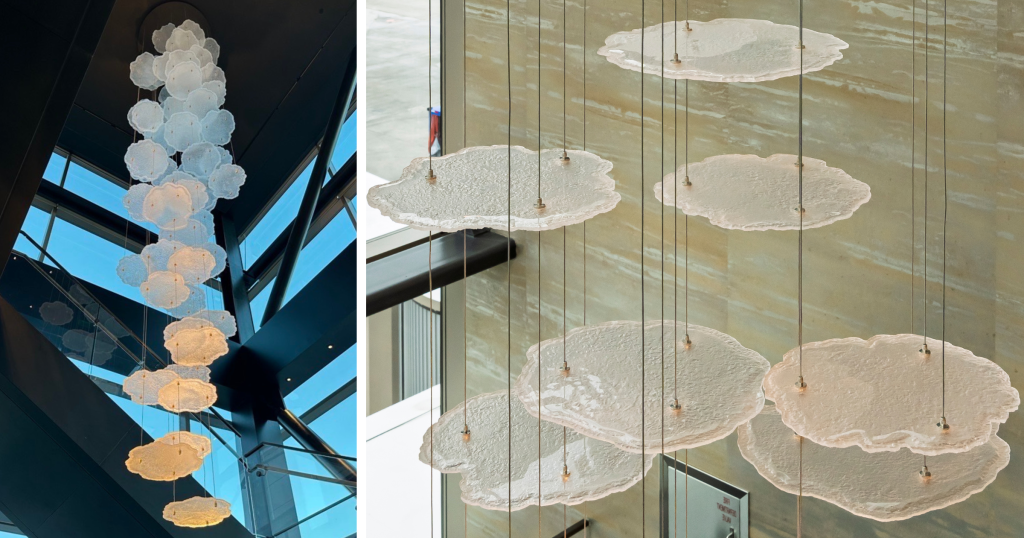
Some surfaces diffuse light into a soft, atmospheric glow. Others catch and fracture illumination, revealing depth and subtle shifts in tone. Together, they create a layered visual experience that changes throughout the day—much like the Salt Flats themselves under different light conditions.
The chandelier rises vertically through the space, forming a cascading composition that feels both structured and organic. Suspended at varying heights, the glass elements create a sense of movement—like a landscape unfolding midair.
And then there’s the scale.
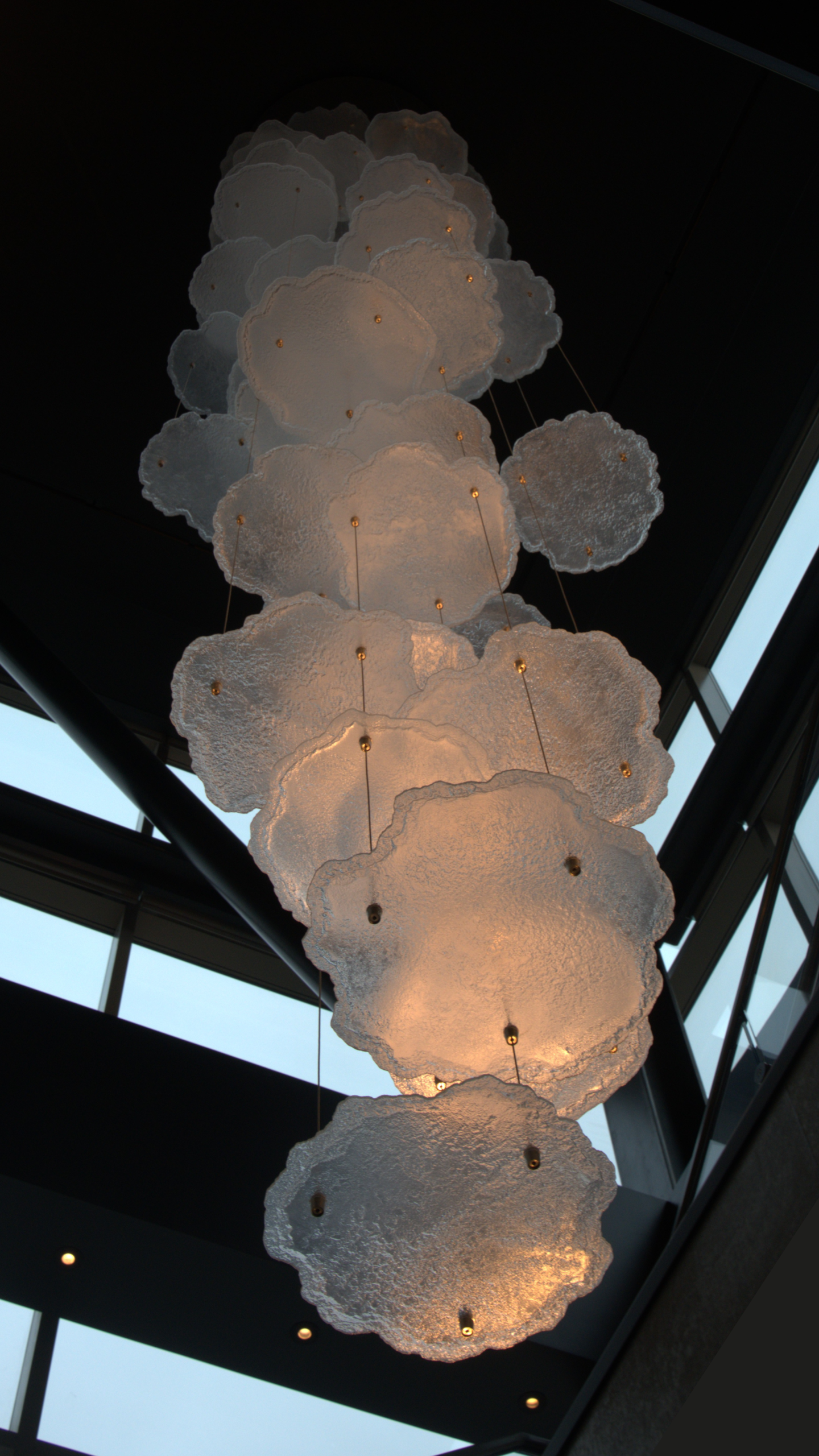
Large installations often risk overwhelming a space, but this 30ft custom art piece was designed with restraint. It draws the eye upward without adding visual weight, becoming a focal point that integrates rather than imposes. In an environment defined by motion, this chandelier offers something rare: a moment of stillness.
Travel is inherently transitional. Spaces like airports are built to move people through, not hold them in place. But when craftsmanship and design are given room to speak, they can alter that experience—if only briefly.
This chandelier does exactly that.
It’s not just a study in form or material. It’s a reflection of process—of what happens when design and craftsmanship are fully aligned and allowed to stay human. From Davis’s conceptual direction to Nick’s hands-on glass development and edge carving, every step was intentional, iterative, and deeply physical.
For Hammerton, this is the essence of custom.
Not replication, but realization. Taking something observed in nature—light, texture, landscape—and translating it into a built form that carries its emotional weight forward.
Because custom lighting, at its best, isn’t just about illumination. It’s about presence.
aRE YOU A TRADE PROFESSIONAL?
At Hammerton, we know what it takes to deliver exceptional design on tight timelines. Our Trade Account Program offers exclusive discounts, product access, and dedicated support to help you stay ahead. Apply now and simplify your workflow from concept to completion.
FAQ:
1. What inspired the look of this custom lighting design?
The fixture draws directly from the Bonneville Salt Flats—specifically their fractured textures, expansive scale, and the way light interacts with the surface. Rather than replicating the landscape, the design abstracts its natural patterns into a suspended, sculptural form.
2. What makes kiln-fused glass ideal for this project?
Kiln-fused glass allows for controlled texture and organic shaping that would be difficult to achieve through other methods. By carefully managing heat and timing, each piece develops subtle variation while maintaining structural integrity—resulting in glass that diffuses and reflects light in a dynamic way.
3. How was the custom mold created?
The mold was developed in-house by Hammerton’s engineering team, beginning with hand-sculpted forms to achieve the desired texture. It was then refined for consistency and durability, ensuring it could produce multiple unique glass elements while maintaining the integrity of the overall design.
4. How do you maintain consistency across a large-scale installation with unique pieces?
While each glass element is intentionally one-of-a-kind, consistency is achieved through controlled processes—custom molds, precise kiln cycles, and rigorous quality checks. This balance allows the installation to feel cohesive without losing its organic variation.
5. What challenges come with designing lighting for an airport environment?
Airport installations require careful consideration of scale, durability, and visual impact. The fixture must hold presence within a large, high-traffic space while integrating seamlessly into the architecture. It also needs to perform consistently over time, both structurally and in how it delivers light.